


The best areas to stay in Kyoto (for your first trip!)

If you have been reading my blog before, you were probably Dutch. As you know, I usually write everything in Dutch, but for this post, I’m making an exception. I frequently get asked on social media (especially TikTok) and by friends, both from my side and Zen’s the same question: "Where is the best place to stay in Kyoto?"
That’s why I decided to make this guide available in English as well. This blog is mainly intended for first-time visitors to Kyoto. Of course, the information is still useful if you've been here before, but once you're used to the Japanese system (the trains, buses, etc.), you might actually prefer staying in a quieter residential neighborhood. Well, let’s get into it!
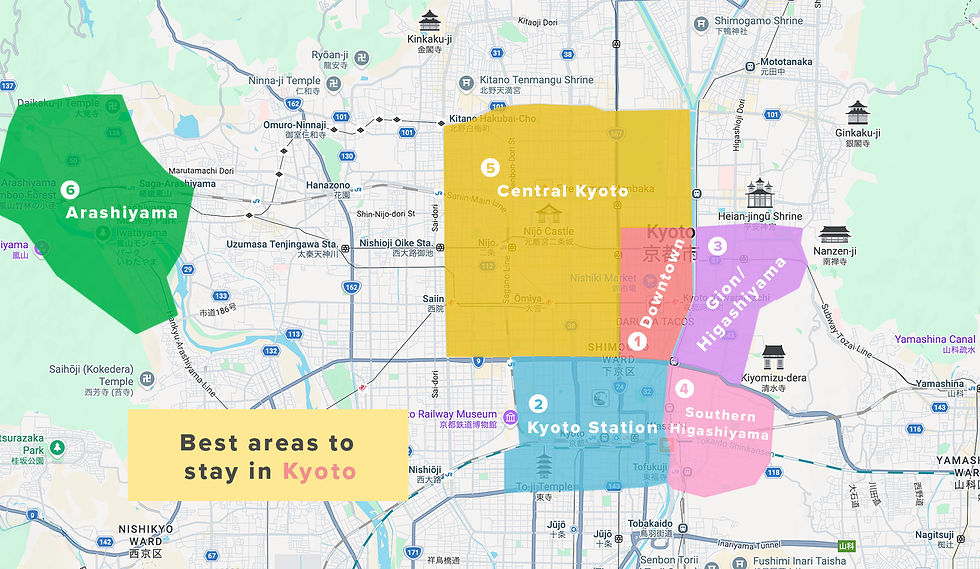
The Map: Where should you stay?
On the image I created, you can see that I have divided Kyoto into several colored sections. Of course, you can stay in the uncolored areas as well, but: when I see tourists walking there, I often think "What are you doing here?" Those areas are mostly residential neighbourhoods without any sightseeing locations nearby.
Just a small disclaimer: feel free to do whatever you like! This is purely my advice as someone who has lived in Kyoto for a several years now. Also, keep in mind: this map is ideal for tourists, but it is not necessarily the best advice if you are looking to actually move here and live in the city.
1. Downtown
Downtown is the beating heart of the city and the place where modern life and tradition meet. It is lively, busy, and full of tourists, but for good reason. In my opinion, this is the most convenient place to stay because you are literally close to everything. You can even reach many sights just by walking.
What is there to do? You are within walking distance of the historic Gion district(maps) and the famous Nishiki Market (which I personally would avoid on weekends, maps). For shoppers, you will find large department stores here like Daimaru (maps) and Takashimaya (maps). Be sure to visit the basement floors (depachika) of these stores for the most delicious food!
Culture & Relaxation: Feel like something other than temples? The Kyoto International Manga Museum (maps) is just around the corner. And if you want to escape the crowds for a bit, you can easily walk to the Kamogawa River (maps). This is the perfect spot for a sunset stroll or to sit by the riverbank with a drink in the evening, just like the locals do.
Staying here: Because this is the most popular area, it can be a bit difficult to find hotels and they are often the most expensive. However, you get a prime location and a great atmosphere in return.

2. Kyoto Station Area
If I were to visit Kyoto as a tourist myself, I would probably stay here. It is slightly quieter than Downtown and although the distances to some temples are a bit longer, being at the main station puts you right at the heart of all the trains and buses that take you everywhere in the city and beyond.
Sights: Right on your doorstep stands the iconic Kyoto Tower (maps), where you have a great view of the city. Within walking distance you will find the impressive To-ji Temple (maps), known for the tallest wooden pagoda in Japan. For a modern twist, you can visit TeamLab Biovortex (maps) and the Kyoto Railway Museum (maps), which is surprisingly fun even if you are not a train enthusiast.
Food and shopping: In and under the station you will find Porta, an underground shopping mall with many restaurants.
Location: This is the ultimate hub. Do you want to take a day trip to Osaka, Nara, or Fushimi Inari (maps)? From here, you can reach your destination within 10 to 45 minutes. You save yourself a lot of lugging around with suitcases!

3. Gion / Higashiyama
This is the district you know from the pictures: authentic Kyoto. Think of the iconic Hanamikoji Dori (maps), old traditional buildings, and the chance to spot a Maiko.
What is there to see? This is the place for those iconic shots. You will find the Yasaka Shrine (maps) here and the beautiful wooden Hokan-ji Pagoda (also known as the Yasaka Pagoda). The surrounding streets, such as Sannenzaka (maps) and Ninenzaka (maps), are full of traditional teahouses, souvenir shops, and places to grab street food. Many tourists rent a kimono here to walk through the historic alleys.
Location: You are very close to the famous Kiyomizu-dera temple (maps). From here, it is also an easy walk across the river toward Downtown for shopping or dining out.
Staying here: The hotels and Ryokans (traditional hotels) here often have a beautiful historic touch, which is exactly what you expect from Kyoto. Keep in mind that this area is one of the most expensive places to stay and it can get extremely crowded during the day.


4. Southern Higashiyama
It is much quieter here than in the heart of Gion (point 3) (maps). You are located a bit further south, right between the tourist highlights and Kyoto Station. This is an ideal spot if you want the atmosphere of the old city, but not the intense crowds right outside your hotel door.
What is there to see? In this area, you will find beautiful, vast temple complexes that are often much more peaceful. A definite must-visit is the Tofuku-ji temple (maps). The Sanjusangendo temple (maps), with its 1,001 golden statues, is also located in this neighborhood and is great to visit.
Location: From here, you can get to the station in no time, but you can also easily catch a train or bus to other parts of the city. Additionally, a twenty-minute walk through charming streets will take you toward the foot of Kiyomizu-dera (maps).
Atmosphere: If you decide to explore this area on foot, you will pass many smaller, hidden temples and local craft shops. It is the perfect place for travelers who enjoy walking and want to discover the more serene side of Kyoto.
5. Central Kyoto
This is a fairly large area and it is where you often find the "hidden gems." Because the area is so spacious, you will find many modern hotels here that are priced much more competitively than those in the busy tourist districts. It is a nice mix of residential life, business, and tourism.
What is there to see? The two main attractions are the Kyoto Imperial Palace (maps) (with the giant park surrounding it) and Nijo Castle (maps).
Food and Drink: If you love good food without the "tourist tax" of Downtown, this is the place to be. There are countless small Izakayas (Japanese pubs), authentic ramen shops, and trendy coffee bars tucked away in the side streets. Many restaurants here are a lot cheaper than in Gion (maps), but the quality is often even better.
Atmosphere: It is much quieter on the streets here, which is lovely after a busy day at the temples. The streets are wide and you get to see the daily life of Kyoto’s residents. It is also a very bike-friendly area!
Location: Because of its central location, you can take the metro (Karasuma or Tozai line) to reach both the station and the east side of the city very quickly.

6. Arashiyama
I recommend everyone to visit Arashiyama (maps), but honestly, I wouldn't recommend staying there for your entire holiday. I included it on the map because I know many people look into this area for its nature. Arashiyama is located in the far west and is quite far from the other locations.
What is there to see? Of course, you will find the world-famous Bamboo Forest (maps) here. But there is more: cross the iconic wooden Togetsukyo Bridge (maps) or visit the Iwatayama Monkey Park (maps), where you have a great view of the city while monkeys roam around you. You also shouldn't miss the Tenryu-ji (maps) temple, which has one of the most beautiful gardens in Kyoto.
The atmosphere: This part of Kyoto is very green and traditional, but it is very much geared toward day tourists. As soon as the sun goes down and the shops close, it becomes very quiet.
Staying here: Why would you choose to stay here? For the ultimate luxury experience. Some of the most exclusive Ryokans (traditional hotels) are located here along the river. If you really want to splurge for a night and unwind in nature, this is the place.
Location: It is quite a long trip from the center. That is why my advice is usually to book a hotel in Downtown or near the station, and set aside one full day for Arashiyama.

Conclusion: Where are you going to stay?
I hope this map and the explanation help you choose the area that best fits your trip! Kyoto is a city with a lot of diversity; whether you choose the modern energy of Downtown, the convenience of the Station area, or the historical touch of Gion, you are going to have an amazing time in Kyoto.
My final tip: book your stay as early as possible! Kyoto is more popular than ever and the best spots in the popular neighborhoods are often booked months in advance.
Do you still have questions after reading this, or are you doubting between two areas? Let me know in the comments below or send me a message on TikTok or Instagram.
Enjoy your time in my favorite city. Safe travels!


Comments